


Here’s a quick insight from U-Vest Financial's CEO, Michael Davino, on navigating market fluctuations. Feel free to share it with colleagues, friends, or family who may find it valuable.
Understanding Market Corrections vs. Bear Markets
Market corrections are a natural part of the stock market cycle. They contribute to the long-term health of market indexes. However, the key question remains: Is this a correction within a longer-term bull market, or are we entering a bear market?
Our goal in this short piece is to explain how the U-Vest® investment management team approaches this question.
The Trend is Your Friend
The prevailing trend should be given the benefit of the doubt, and at present, we remain in a bull market. A healthy bull market experiences corrections periodically, making them buying opportunities rather than triggers for fear-based selling. By maintaining focus on the longer-term trend, investors can position themselves strategically.
For example, we are closely monitoring a multi-year trend chart for the Nasdaq 100 (NDX), which has been a key driver of the bull rally. As of March 10, 2025 (estimated at 1 PM), this index is touching a significant trendline, making this a key point for evaluating potential buying opportunities.
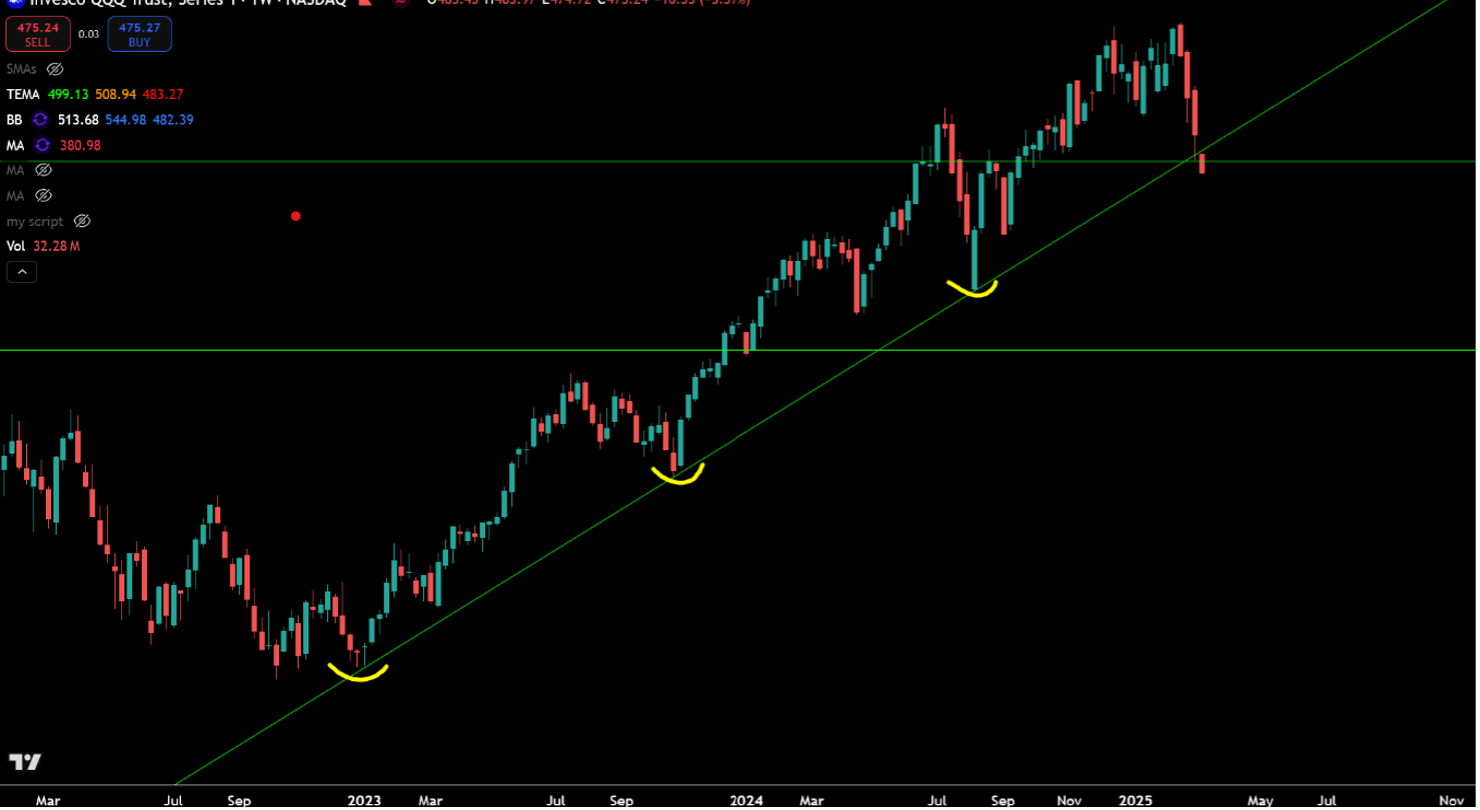
Chart of the Nasdaq 100 index, longer term “Weekly” trendline, we are monitoring.
What If the Trend Shifts to a Bear Market?
This is where our commitment to Active Management becomes essential. Unlike passive investing, which follows the market regardless of conditions, active management allows us to identify opportunities while maintaining defined risk levels.
Using our trend chart, a shift to a bear market would be signaled by the formation of a "lower high" on the weekly chart. If this occurs, our correction-based purchases may still be profitable in the short term. However, should lower highs and lower lows develop—a classic bear market pattern—we would adjust our strategy accordingly to mitigate risk.
At U-Vest® Financial, we emphasize adaptability. While the current trend supports a long-term bull market, our active management approach ensures we are prepared to take action if conditions change. Passive index investors, on the other hand, may find themselves simply along for the ride.
Diversified Portfolio Management: A Fundamental Approach
Understanding the composition of your portfolio is crucial during correction periods. In a March 2022 blog post, we highlighted the significant concentration of the top 10 mega-cap companies in the S&P 500 index. As of February 28, 2025, these companies now represent 36.4% of the index’s total weight (Reference JP Morgan Guide to the markets). This marks a record level, with the remaining 490 companies significantly underweighted compared to historical norms.
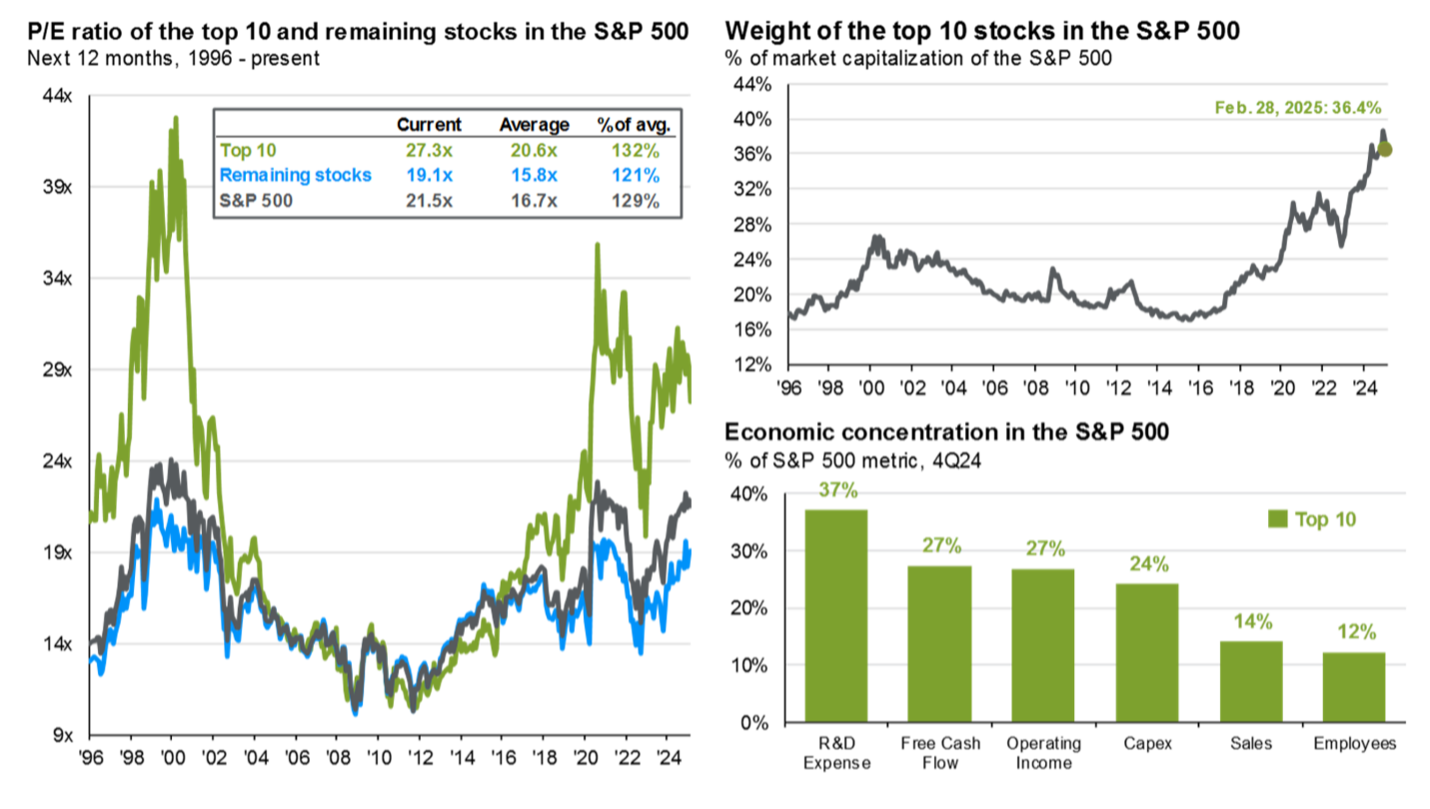
Given this trend, we believe that an Actively Managed, Diversified Portfolio is better positioned for potential market shifts. While passive S&P 500 index funds have performed well over the past decade, we anticipate greater benefits from a more balanced U.S. stock market. This includes increased allocations to small- and mid-cap stocks, international investments, and undervalued large-cap stocks (value investments).
You may also read a prior blog I wrote in March 2022 highlighting this top 10 weighting (Read blog here), for historical context to our position / stance on this.
Media & Market Corrections
Perhaps the most challenging aspect of market corrections is navigating the 24/7 media cycle. Every correction in modern history has been accompanied by headline-making news events:
- June 2016: Brexit uncertainty led to a market correction.
- December 2018: Concerns over U.S.-China tariffs and Federal Reserve interest rate hikes drove a correction.
- February-March 2020: COVID-19 shutdowns triggered a major downturn.
Each of these events presented compelling media narratives, yet they ultimately proved to be strong buying opportunities. In the last decade, only the January 2022 correction extended into a prolonged bear market (lasting 10 months, which is relatively short historically).
While news events are undeniably important, we encourage investors to separate news cycles from investment strategies. At U-Vest®, our focus remains on data, charts, and market fundamentals. Rather than reacting to the current news story, we are proactively seeking to capitalize on market volatility for long-term gains.
Our best advice? View market news and your investment strategy as separate entities. There is little long-term correlation between the two.
Connect with a U-Vest® Financial Advisor
Whether you’re a current U-Vest® Financial client or simply looking for a professional portfolio review, our team is here to help. Contact us during regular market hours at 1-833-572-2288 or email invest@u-vestfinancial.com.
With offices in Florida, Georgia, Alabama, and South Carolina, U-Vest Financial has been recognized as a Forbes Best-In-State Wealth Management Team and is among the Top 100 financial advisory teams at broker-dealer LPL Financial. We proudly serve over 3,000 clients nationwide.
Learn more about our team at: www.u-vestfinancial.com/meet-the-team
Content in this material is for general information only and not intended to provide specific advice or recommendations for any individual. All performance referenced is historical and is no guarantee of future results. All indices are unmanaged and may not be invested into directly. There is no guarantee that a diversified portfolio will enhance overall returns or outperform a non-diversified portfolio. Diversification does not protect against market risk.